Harvard’s computers
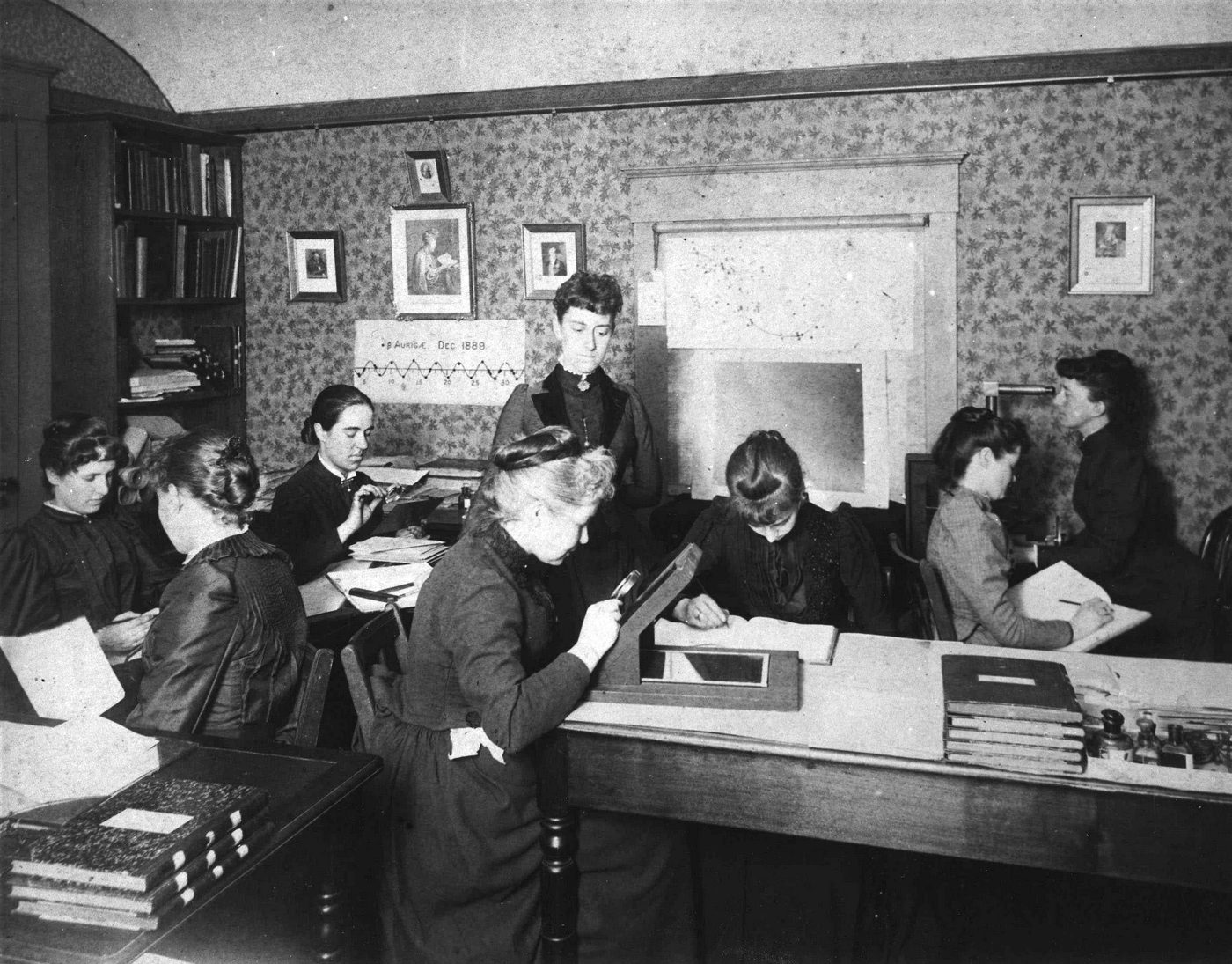
Harvard College Observatory, via Wikimedia Commons. Public domain.
From 1881 the Harvard College Observatory’s director, Edward Pickering, hired “Women Astronomical Computers” to study its glass photographic plates. They catalogued stars, discovered variable stars and studied stellar spectra (Harvard Plate Stacks, Women at the Harvard College Observatory). The work produced real science. Henrietta Swan Leavitt, measuring star brightness on the plates, discovered the relation between the period and luminosity of Cepheid variables, the first “standard candle” for measuring distances to faraway galaxies (Wolbach Library (Harvard), Henrietta Swan Leavitt).
The largest computing office in the world
In 1938 the New Deal’s Works Progress Administration set up the Mathematical Tables Project in New York City, in an industrial loft near Columbus Circle. At its peak about 450 people worked there, which NIST calls the largest computing organisation in the world (NIST, “Prehistory: The Math Tables Project”).
Most of the computers were unskilled. Most did only addition. Because many didn’t understand negative numbers, the project used black and red pencils. The project produced 37 volumes of mathematical tables, and in wartime it worked on navigation and ballistics tables and calculations for the Manhattan Project (NIST, “Prehistory: The Math Tables Project”).
Firing tables and wind tunnels
At the Army’s Ballistic Research Laboratory, women “computors” using desk calculators struggled to keep up with demand for artillery firing tables. ENIAC was built to do that work (National Museum of the United States Army, ENIAC).
At NACA’s Langley laboratory, five women formed the first computer pool in 1935. By 1946 about 400 had been trained (NASA, “When the Computer Wore a Skirt: Langley’s Computers, 1935–1970”). From the 1940s Langley recruited Black women with college degrees into the segregated “West Area Computers.” Human computers worked at the lab into the 1970s (NASA, “When the Computer Wore a Skirt: Langley’s Computers, 1935–1970”).
Towers of clerks
Insurers built some of the biggest clerical workplaces. A 1911 postcard of Metropolitan Life’s Madison Square home office, then billed as the largest office building in the world, shows rows of women among card cabinets (Museums Victoria, MetLife Home Office postcard, 1911). By 1938 the home office held 14,500 workers (Wikipedia, “Metropolitan Life Insurance Company Tower”).
Elon Musk has used this history to explain AI. In an early-2026 interview he said: “Being a computer used to be a job.” He added: “So now one laptop with a spreadsheet can outperform a skyscraper full of several hundred human computers” (Transcript of Elon Musk on the Moonshots podcast (Peter Diamandis), Feb 2026).
What the popular version gets wrong
Popular version Entire buildings in New York did manual accounting for banks.
What the record shows Partly right, but not quite. The best-documented New York towers of clerks belonged to insurers like Metropolitan Life, whose home office held 14,500 workers by 1938 (Wikipedia, “Metropolitan Life Insurance Company Tower”). They did record-keeping and administration as well as calculation. New York did have a building full of human computers, but it did scientific tables, not bank accounts (NIST, “Prehistory: The Math Tables Project”). We found no source documenting a whole building doing banks’ manual accounting.
Popular version Electronic computers ended the job at once.
What the record shows Langley employed human computers from the mid-1930s into the 1970s (NASA, “When the Computer Wore a Skirt: Langley’s Computers, 1935–1970”).
Popular version Human computers were just clerks.
What the record shows It varied. Langley recruited women with maths and science degrees (NASA, “When the Computer Wore a Skirt: Langley’s Computers, 1935–1970”), while most Math Tables Project workers were unskilled and did only addition (NIST, “Prehistory: The Math Tables Project”).
What it means for today
The job title “computer” disappeared. Computing exploded. AI is now aimed at the work that replaced it: reading, writing and analysis at a keyboard. Musk argues that companies run fully on AI will outcompete the rest (Transcript of Elon Musk on the Moonshots podcast (Peter Diamandis), Feb 2026). History supports the direction; the timing is the open question. See Superintelligence and Personal AI agents.
The Future: Superintelligence →
Companies we own that connect to this story (tickers only, never position sizes):
Sources
- Harvard Plate Stacks, Women at the Harvard College Observatory
- Wolbach Library (Harvard), Henrietta Swan Leavitt
- NIST, “Prehistory: The Math Tables Project”
- NASA, “When the Computer Wore a Skirt: Langley’s Computers, 1935–1970”
- National Museum of the United States Army, ENIAC
- Museums Victoria, MetLife Home Office postcard, 1911
- Wikipedia, “Metropolitan Life Insurance Company Tower”
- Transcript of Elon Musk on the Moonshots podcast (Peter Diamandis), Feb 2026
- Wikimedia Commons, Harvard College Observatory computers (c. 1891)
Last reviewed: 22 Oct 2026. Historical figures are quoted as the sources publish them; where sources disagree, we say so.
Not investment advice. History is a lens, not a forecast. This page is opinion and education, researched and presented with the help of AI analyst personas, and may contain errors. The EarlyConviction team holds positions in NVDA, MU, NOW and may buy or sell at any time. Read the disclaimer.