Croppers, stockingers and weavers
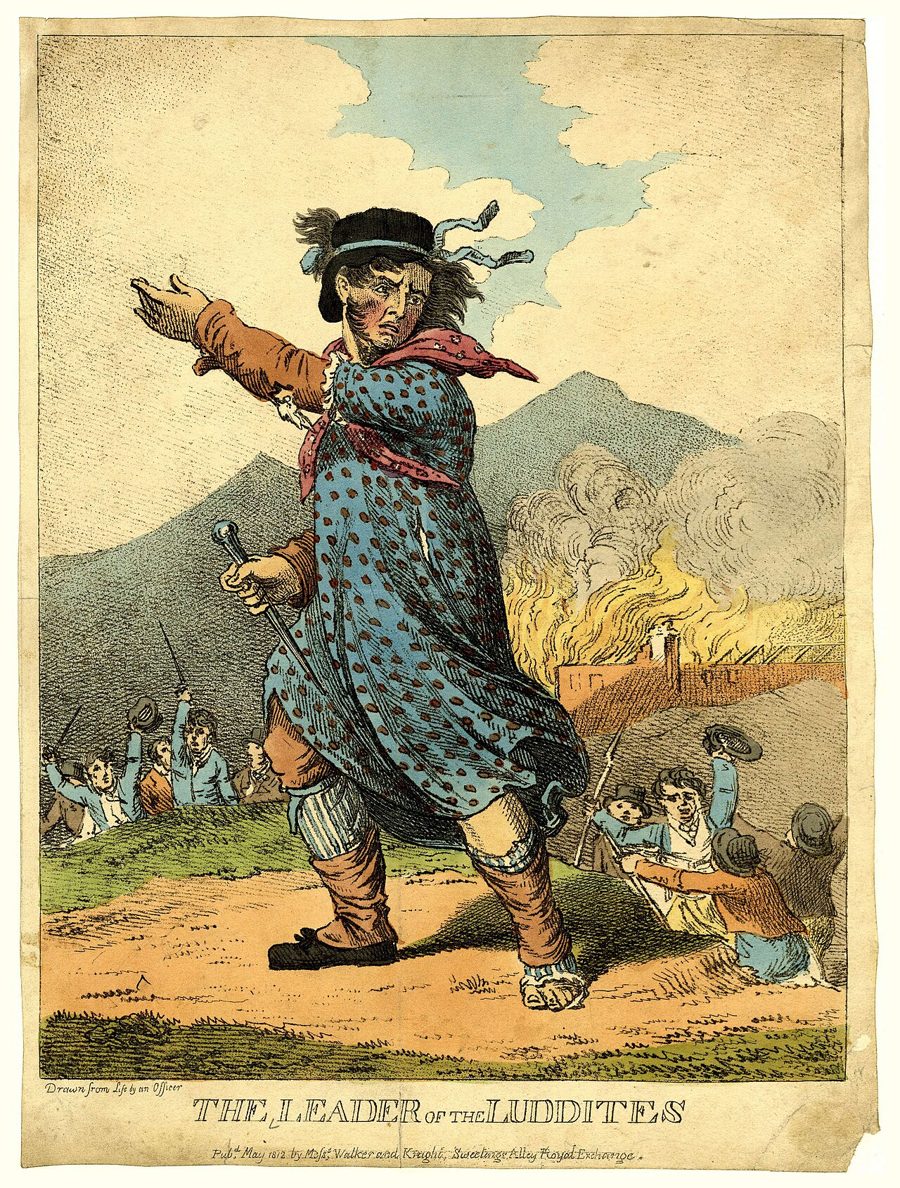
Artist unknown. Via Wikimedia Commons (from the Working Class Movement Library); see also the British Museum record. Public domain (published 1812).
The disturbances began in Nottinghamshire in 1811. In 1812 they spread to the West Riding of Yorkshire and Lancashire, and to Leicestershire and Derbyshire, lasting until 1816 (The National Archives (UK), “Why did the Luddites protest?”). Three groups led them. In the Midlands it was framework knitters, or stockingers, who made hosiery on stocking frames. In Yorkshire it was croppers, the elite cloth finishers, facing shearing frames and gig mills. In Lancashire it was hand-loom weavers facing the power loom (The National Archives (UK), “Why did the Luddites protest?”).
They took their name from “General” or “King” Ned Ludd, a mythical leader said to live in Sherwood Forest (The National Archives (UK), “Why did the Luddites protest?”). He was a fiction, built on a story about an apprentice who smashed a stocking frame decades earlier. Letters signed from “Ned Lud’s Office, Sherwood Forest” mocked the authorities (Smithsonian Magazine, 2011 (Richard Conniff)).
Not machines, but how they were used
Many Luddites were skilled machine operators, and the stocking frame they attacked was more than 200 years old (Smithsonian Magazine, 2011 (Richard Conniff)). Historian Kevin Binfield, who edited the Luddites’ own writings, says they were “totally fine with machines.” They targeted employers who used machinery in what the workers called “a fraudulent and deceitful manner” to undercut wages, apprenticeship and quality (Smithsonian Magazine, 2011 (Richard Conniff)).
The backdrop was hardship. The war with Napoleonic France had made food scarce and expensive, and work was short. The Nottinghamshire protests were against wage cuts. In Yorkshire, workers feared machinery that was already causing unemployment (Smithsonian Magazine, 2011 (Richard Conniff)) (The National Archives (UK), “Why did the Luddites protest?”). A Nottingham reward poster from January 1812 shows how targeted the raids were. Fellow workmen certified that the frames broken in one workshop had all been “working at the FULL PRICE” (The National Archives, reward poster, Jan 1812 (HO 42/119)).
In 1963 E. P. Thompson set out to rescue “the Luddite cropper” and “the ‘obsolete’ hand-loom weaver” from “the enormous condescension of posterity” (E. P. Thompson, The Making of the English Working Class (1963), preface). Brian Merchant’s 2023 history Blood in the Machine makes a similar case. In his reading, the Luddites saw factory owners using machines to replace skilled, well-paid work with cheaper labour, often children, producing lower-quality cloth. They fought that choice rather than the technology (TIME, 2023, on Brian Merchant’s Blood in the Machine).
Soldiers, a capital law and the gallows at York
In February 1812 Parliament made frame-breaking punishable by death (The National Archives (UK), “Why did the Luddites protest?”) (Hansard, House of Lords, 27 Feb 1812 (Frame Work Bill)). In his maiden speech in the Lords, Lord Byron attacked the bill: “Can you commit a whole county to their own prisons? Will you erect a gibbet in every field and hang up men like scarecrows?” (Hansard, House of Lords, 27 Feb 1812 (Frame Work Bill)). He also acknowledged that the improved frames “superseded the necessity of employing a number of workmen, who were left in consequence to starve” (Hansard, House of Lords, 27 Feb 1812 (Frame Work Bill)).
On the night of 11 April 1812, Luddites attacked William Cartwright’s Rawfolds Mill near Liversedge in Yorkshire, which used machinery for finishing cloth. The defenders fired back, and two attackers were mortally wounded (Smithsonian Magazine, 2011 (Richard Conniff)) (York Castle Prison, condemned prisoners records). That same month, near Manchester, a mill owner’s men fired on a crowd of about 2,000, killing at least three (Smithsonian Magazine, 2011 (Richard Conniff)).
About 12,000 troops were deployed in the disturbed districts (WJEC, Popular protest in Wales and England). At the York assizes in January 1813, 64 people were tried and 17 were sentenced to death: five for the Rawfolds attack, three for the murder of mill owner William Horsfall and nine for thefts of arms and money (WJEC, Popular protest in Wales and England). Fourteen were hanged at York on 16 January 1813 (York Castle Prison, condemned prisoners records). The National Archives puts the number executed that year at 17 (The National Archives (UK), “Why did the Luddites protest?”).
Jobs grew, but the craftsmen paid
Over the 19th century, power looms cut the labour needed to weave a yard of cloth by about 98%. Yet the number of factory weaving jobs rose: cheaper cloth meant far more demand. Later in the century, weavers’ wages rose sharply compared with other workers (James Bessen, “Toil and Technology”, IMF Finance & Development, 2015). Economic historians conclude that the Luddites’ fear that machinery would impoverish workers in general wasn’t realized. New technology also created demand for mechanics, supervisors and clerks (Fraser Institute, “Technology, Automation and Employment” (quoting Mokyr et al., 2015)).
For the people who lived through it, the picture was bleak. Hand-loom weavers in the English cotton industry averaged about 240 pence a week in 1806 but less than 100 pence by 1820. Factory workers saw little real wage growth between 1806 and 1835 (Knowable Magazine, 2025 (citing Acemoglu & Johnson)). Both things are true. The economy as a whole gained, and a generation of skilled workers lost.
What the popular version gets wrong
Popular version Craftsmen made clothing by hand, and the machines were brand new.
What the record shows Many Luddites already worked machines. The stocking frame dated back more than two centuries. The fight was over newer, wider frames, shearing frames and power looms, and over how employers used them (Smithsonian Magazine, 2011 (Richard Conniff)).
Popular version They attacked factories because they hated technology.
What the record shows They mostly broke specific frames, often in small workshops and homes, belonging to employers they accused of cutting wages or quality. Binfield says they were “totally fine with machines” (Smithsonian Magazine, 2011 (Richard Conniff)) (The National Archives, reward poster, Jan 1812 (HO 42/119)).
Popular version They thought factories would leave everyone unemployed.
What the record shows Fear of unemployment was real, especially in Yorkshire, but the core demands were about wages, prices and quality in a wartime slump (The National Archives (UK), “Why did the Luddites protest?”) (Smithsonian Magazine, 2011 (Richard Conniff)).
Popular version They made shirts and jeans.
What the record shows They made stockings and hosiery, finished woollen cloth and wove cotton. Blue jeans as we know them date from Levi Strauss and Jacob Davis’s riveted work trousers, patented on 20 May 1873 (Levi Strauss & Co., “Celebrating the birth of the 501 jean”).
Popular version More troops fought the Luddites than fought Napoleon.
What the record shows A popular myth. About 12,000 troops, mostly home militia, were deployed against the Luddites. In 1812 Britain had about 50,000 in the Peninsula, peaking at 73,000 in 1813 (Anton Howes, “Were more troops sent to quash the Luddites than to fight Napoleon?”).
Popular version Machines killed jobs.
What the record shows In aggregate, no: textile employment grew (James Bessen, “Toil and Technology”, IMF Finance & Development, 2015). But the displaced hand-loom weavers saw their earnings collapse (Knowable Magazine, 2025 (citing Acemoglu & Johnson)). The “lump of labour” idea, that there’s a fixed amount of work to go round, misses the new demand that cheaper goods create. It also offers no comfort to the people displaced.
What it means for today
AI agents now raise the same fear for white-collar work. History offers two lessons at once. First, cheaper output tends to grow total demand and create new kinds of jobs, as weaving did (James Bessen, “Toil and Technology”, IMF Finance & Development, 2015). Second, the transition can be brutal for the specific people whose skills are being automated, and how the gains are shared is a choice, not a law of nature (TIME, 2023, on Brian Merchant’s Blood in the Machine).
As investors, we watch who captures the value: the platforms that put AI to work and the infrastructure underneath them. See Personal AI agents and Superintelligence.
The Future: Personal AI agents →
Companies we own that connect to this story (tickers only, never position sizes):
Sources
- The National Archives (UK), “Why did the Luddites protest?”
- The National Archives, reward poster, Jan 1812 (HO 42/119)
- Smithsonian Magazine, 2011 (Richard Conniff)
- Hansard, House of Lords, 27 Feb 1812 (Frame Work Bill)
- WJEC, Popular protest in Wales and England
- York Castle Prison, condemned prisoners records
- Anton Howes, “Were more troops sent to quash the Luddites than to fight Napoleon?”
- E. P. Thompson, The Making of the English Working Class (1963), preface
- TIME, 2023, on Brian Merchant’s Blood in the Machine
- Levi Strauss & Co., “Celebrating the birth of the 501 jean”
- James Bessen, “Toil and Technology”, IMF Finance & Development, 2015
- Knowable Magazine, 2025 (citing Acemoglu & Johnson)
- Fraser Institute, “Technology, Automation and Employment” (quoting Mokyr et al., 2015)
- Wikimedia Commons, “The Leader of the Luddites” (1812)
- British Museum, P_1990-1109-86
Last reviewed: 22 Oct 2026. Historical figures are quoted as the sources publish them; where sources disagree, we say so.
Not investment advice. History is a lens, not a forecast. This page is opinion and education, researched and presented with the help of AI analyst personas, and may contain errors. The EarlyConviction team holds positions in NOW, PLTR, ADBE, NVDA and may buy or sell at any time. Read the disclaimer.