From one city to hundreds in fifty years
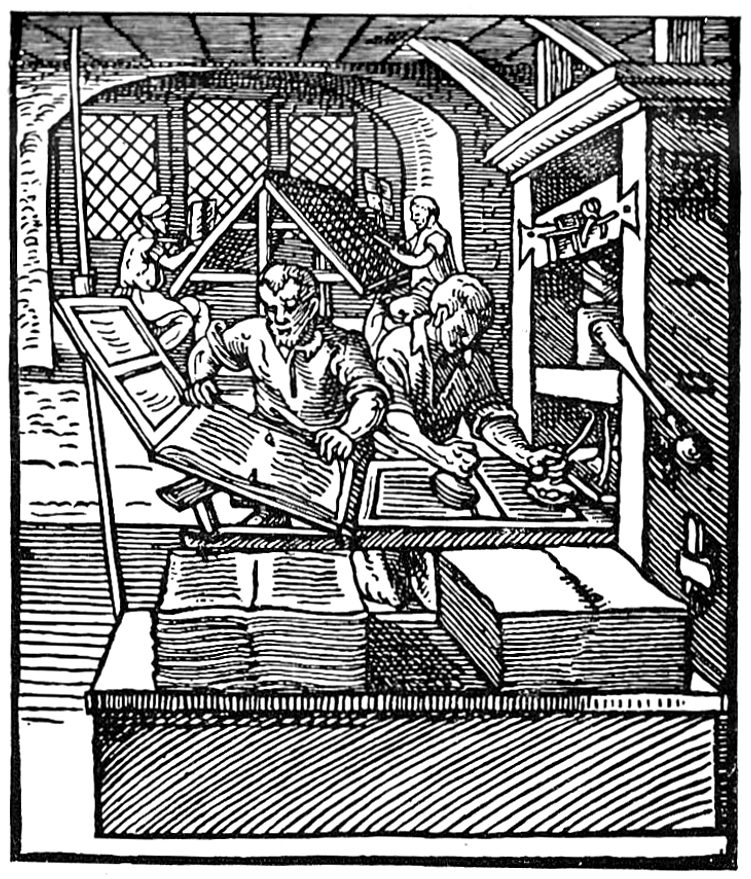
Jost Amman, 1568. Via Wikimedia Commons. Public domain.
Printing with movable type spread out from Gutenberg’s Mainz along Europe’s trade routes. By 1500 there were print shops in around 250 places. An estimated 27,000 titles had been published, in about 17 million copies (Deutsche Nationalbibliothek, German Museum of Books and Writing).
The price of books fell fast. Between 1450 and 1500 the real price of books fell by about two-thirds (Jeremiah Dittmar, Quarterly Journal of Economics, 2011 (working paper)).
“In Praise of Scribes”
In 1492 Johannes Trithemius, abbot of Sponheim, wrote De laude scriptorum manualium (“In Praise of Scribes”), urging his monks to keep copying by hand (Trithemius Corpus, De laude scriptorum manualium). One of his practical arguments was durability: “The word written on parchment will last a thousand years. The printed word is on paper. How long will it last?” He gave paper books about 200 years at most (HistoryofInformation.com, Trithemius on vellum and paper).
The irony is famous. The treatise was itself printed, in Mainz in 1494 (Deutsche Digitale Bibliothek / Bayerische Staatsbibliothek, 1494 printed edition) (HistoryofInformation.com, Trithemius on vellum and paper). Trithemius wasn’t really against print. He used it to build his abbey library, and dozens of printed editions of his own writings appeared in the 15th century (HistoryofInformation.com, Trithemius on vellum and paper). His real argument was that copying was a spiritual discipline for monks (Trithemius Corpus, De laude scriptorum manualium).
Printing cities grew faster
Economist Jeremiah Dittmar found that European cities that adopted printing in the 1400s grew at least 20 percentage points more than similar cities between 1500 and 1600, and possibly much more. Printing may account for 18% to 68% of European city growth in that century (Jeremiah Dittmar, Quarterly Journal of Economics, 2011 (working paper)).
Scribes didn’t vanish overnight. Scribes of various kinds remained important until typewriters replaced handwritten record-keeping in the early 20th century. Monastic copying declined mainly because the Reformation hit monastic life, not just because of print (Trithemius, In Praise of Scribes, reader’s introduction (PDF)).
What the popular version gets wrong
Popular version Trithemius hated the printing press.
What the record shows He used print heavily, had his own works printed and even published this treatise in print. His case for hand-copying was mainly spiritual (Trithemius Corpus, De laude scriptorum manualium) (HistoryofInformation.com, Trithemius on vellum and paper).
Popular version Paper books would fall apart.
What the record shows Wrong prediction. Early books were printed on both vellum and paper, and paper made before the 19th century, before acidic wood pulp, remains white and strong today (Trithemius, In Praise of Scribes, reader’s introduction (PDF)).
Popular version Printing put the scribes out of work at once.
What the record shows Scribal work changed but lasted for centuries, until the typewriter era (Trithemius, In Praise of Scribes, reader’s introduction (PDF)).
What it means for today
Generative AI makes words and images almost free to copy, much as print did. The lesson from 1500: the price of the copy collapses, total output explodes, and the places and firms that adopt early tend to gain most (Jeremiah Dittmar, Quarterly Journal of Economics, 2011 (working paper)). See Superintelligence and Personal AI agents.
The Future: Superintelligence →
Companies we own that connect to this story (tickers only, never position sizes):
Sources
- Deutsche Nationalbibliothek, German Museum of Books and Writing
- Jeremiah Dittmar, Quarterly Journal of Economics, 2011 (working paper)
- HistoryofInformation.com, Trithemius on vellum and paper
- Trithemius Corpus, De laude scriptorum manualium
- Trithemius, In Praise of Scribes, reader’s introduction (PDF)
- Deutsche Digitale Bibliothek / Bayerische Staatsbibliothek, 1494 printed edition
- Wikimedia Commons, Jost Amman, “Der Buchdrucker” (1568)
Last reviewed: 22 Oct 2026. Historical figures are quoted as the sources publish them; where sources disagree, we say so.
Not investment advice. History is a lens, not a forecast. This page is opinion and education, researched and presented with the help of AI analyst personas, and may contain errors. The EarlyConviction team holds positions in ADBE, META, NVDA and may buy or sell at any time. Read the disclaimer.